Home / About
About the surgeonDr. Akshat Srivastava
Orthopaedic surgeon focused on joint reconstruction — from robotic-assisted primary replacement to the complex end of the specialty: revisions, deformed and destroyed joints, pelvi-acetabular trauma, and sports injuries of the knee and shoulder.
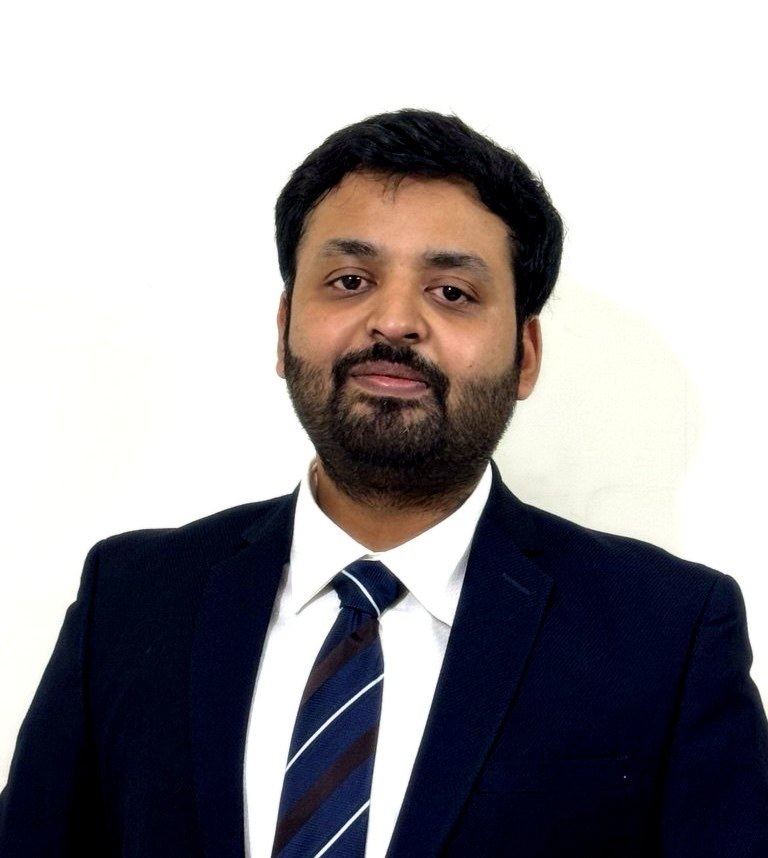
Dr. Akshat Srivastava
MBBS (AIIMS) · MS Ortho (PGI) · DNB · MRCS-A
Trained at India's premier institutes
Dr. Srivastava completed his MBBS at the All India Institute of Medical Sciences (AIIMS) and his MS in Orthopaedics at the Postgraduate Institute of Medical Education & Research (PGIMER), Chandigarh — two of the most competitive training programmes in Indian medicine — followed by DNB certification from the National Board of Examinations, Delhi, and membership of the Royal College of Surgeons of England (MRCS-A).
Seven years at PGIMER Chandigarh — an apex institute of national importance, where the country's most complex orthopaedic cases arrive for a final answer — took him through MS residency and Senior Residency in one of India's busiest trauma and reconstruction services. Training at that altitude leaves a permanent mark: every implant choice, every incision, every rehabilitation protocol must be defended by evidence. That discipline did not stay behind at PGI — it examines every case in this practice.
He served as Consultant in Robotic Joint Replacement at Shalby Hospital, Mohali, one of India's highest-volume arthroplasty centres, before establishing his practice across Lucknow and Ayodhya.
The road home
The conventional next step after that training was obvious: a metro corporate hospital, where surgeons with this pathway usually settle. Dr. Srivastava chose differently — he came home. Ayodhya is where he grew up, and he consults there every weekend; Lucknow, with its tertiary hospital infrastructure, is where he bases the high-risk end of his work — complex and revision arthroplasty, pelvi-acetabular reconstruction, complex sports injuries and major trauma. The reason is simple: care at this level has always required patients from these cities to board a train to Delhi, Mumbai or Ahmedabad. That journey costs families time, money and, in trauma, the treatment window itself. Bringing tertiary-level orthopaedic care to his own people, in their own cities, is not a compromise on ambition; it is the point of it.
- MBBSAll India Institute of Medical Sciences (AIIMS)
- MS ORTHOPostgraduate Institute of Medical Education & Research (PGIMER), Chandigarh
- SREx-Senior Resident, PGIMER, Chandigarh
- DNBNational Board of Examinations, Delhi
- MRCS-AMember, Royal College of Surgeons of England
- CONSULTANTRobotic Joint Replacement, Shalby Hospital, Mohali
- REGISTRATIONMedical registration no. UPMC-135450 — Uttar Pradesh Medical Council
- LIFE MEMBERIndian Association of Age Management (IAAM) - LM0071
- PUBLICATIONCo-author, book chapter on core decompression for avascular necrosis of the hip (Springer)
Career timeline
- FoundationMBBS - All India Institute of Medical Sciences (AIIMS)Medical training at the country's most competitive entrance.
- SpecialisationMS Orthopaedics - PGIMER, ChandigarhResidency at the apex institute where the most complex cases arrive for a final answer.
- MasterySenior Residency - PGIMER, ChandigarhSeven total years in one of India's busiest trauma and reconstruction services.
- CertificationDNB - NBE Delhi / MRCS-A - Royal College of Surgeons of EnglandNational board certification and international membership by examination.
- ConsultantRobotic Joint Replacement - Shalby Hospital, MohaliConsultant practice in a dedicated high-volume robotic arthroplasty unit.
- 2026 - PresentPractice - Lucknow & AyodhyaJoint replacement and reconstruction across two cities: weekday OPD in Lucknow, weekend OPD at J P Memorial Hospital, Ayodhya.
Philosophy of practice
Three principles run through this practice. First, surgery is the last resort, offered decisively when it is the right one — patients who can be treated without an operation are told so plainly. Second, precision is not optional: the same planning discipline learned in robotic arthroplasty — templating, alignment, balance — is applied to every case. Third, the difficult cases belong somewhere: failed replacements, fused joints, shattered sockets and "untreatable" shoulders deserve a surgeon who takes them on rather than turns them away.
Selected publications
- Co-author, book chapter: Core Decompression — in a Springer-published reference volume on avascular necrosis of the hip.
- Morel-Lavallée lesions: size matters? Treatment and time of disability — is the evidence enough? Injury — International Journal of the Care of the Injured, 2023.
- The burden of post-traumatic amputations in a developing country: an epidemiological study from a level I trauma centre. Injury, 2022.
- Letter to the Editor: Long versus short segment instrumentation in osteoporotic thoracolumbar vertebral fracture. Asian Spine Journal, 2021.
- Letter to the Editor: Is older age a contraindication for single-level transforaminal lumbar interbody fusion? Asian Spine Journal, 2021.
- The "Kickstand Rod" technique for correction of coronal imbalance in patients with adult spinal deformity: theory and technical considerations. Journal of Spine Surgery, 2018.
Recognitions, memberships and a featured video are collected on the Awards & recognitions page.
Full academic profile: Academia.edu — Akshat Srivastava, PGIMER.
Consultation
OPD runs Monday to Friday in Lucknow and Saturday–Sunday in Ayodhya. Reports can be sent in advance for a structured second opinion.
Consult in Lucknow or Ayodhya
Weekday OPD in Lucknow, weekend OPD in Ayodhya. Call or send your reports on WhatsApp to begin.
Call to book WhatsApp reports / X-rays